
Table of Contents
Betting the NBA feels unique because the league is built on constant change. Lineups shift, minutes fluctuate, pace varies by opponent, and the schedule can create hidden advantages and disadvantages every single night. Strategies that work in other sports do not always translate cleanly to basketball, because one player’s availability can reshape both the matchup and the market. The goal is not to predict every outcome perfectly. The goal is to build a repeatable process that helps you find value, control your price, and make smarter picks over the long run.
This article blends two essentials into one complete guide: a practical approach to NBA handicapping and a clear understanding of juice (vig), the built-in cost that affects your profitability. If you do the fundamentals well—read odds correctly, shop lines, and respect injury and schedule context—you give yourself a real edge compared to bettors who only chase “who’s better.”
Key NBA Betting Markets You’ll Use Most
Most NBA bettors can cover a lot of ground by mastering a handful of markets first. Once these are comfortable, you can branch into props and parlays with better discipline.
| Market/Term | What it means (and why it matters) |
|---|---|
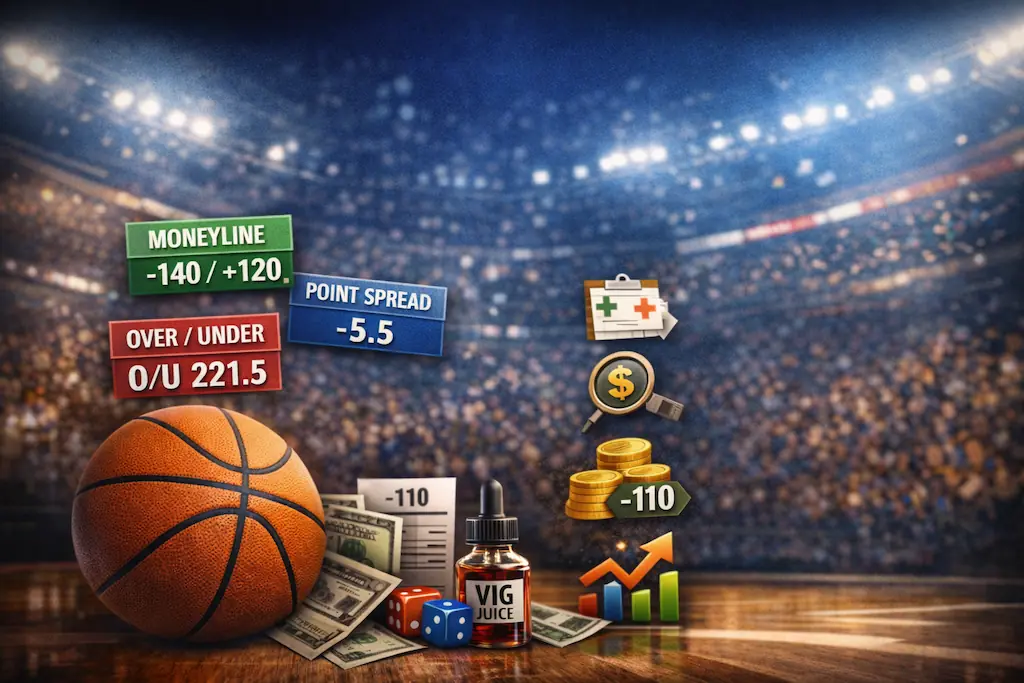
| Moneyline | You pick the winner straight up. Favorites cost more; underdogs pay more. |
| Spread | Points added/subtracted to balance teams; often a better price than a heavy moneyline. |
| Totals | Bet over/under total points; strongly influenced by pace, efficiency, and rotations. |
| Player props | Bets on individual stats; hinges on role, usage, and minutes. |
| Parlays | Combine bets for a larger payout; risk rises quickly with each added leg. |
| Odds | The price you pay for a bet; price is as important as the prediction. |
| Juice (vig) | The built-in commission in the line; it quietly decides your long-term ROI. |
Track the Injury Report the Right Way
If you want to know how to bet the NBA intelligently, injuries are a major starting point—but not in a superficial way. Many bettors only react to whether a star is in or out. Better handicapping comes from understanding how a team changes when a player is missing, limited, or returning.
Think about availability in terms of role and ripple effect. When a high-usage scorer sits, the shot distribution changes. When a primary ball-handler sits, the offense might slow down, turnovers can spike, and the team’s ability to create good looks late in possessions often drops. When a defensive anchor sits, the same opponent shots become higher quality, which can matter more for a total than the headline name itself.
Also, “active” does not always mean “normal.” Players coming back from injury may have minute limits, and that can impact spreads, totals, and props in different ways. A team might survive for 24 minutes with a limited star and still fall apart when the bench closes. That nuance is where many lines are misread.
Use the Schedule as a Handicapping Input, Not Trivia
NBA scheduling spots are not just conversation starters; they are part of the number. Fatigue can show up in defense first, then on jump shots late, and it often changes rotation patterns. The second night of a back-to-back, long travel, time zone changes, and compressed stretches can all influence both performance and coaching decisions.
The key is not blindly fading teams in tough spots. It is identifying when the market overprices or underprices the schedule impact. Sometimes a team is on a back-to-back but has depth and a style that travels well, and the market punishes them too hard. Other times, the spot is truly brutal—especially when travel is involved—and the line does not adjust enough.
When you combine schedule context with injury context, you start to see clearer edges. A team on short rest might handle a normal opponent, but not if they are missing a primary creator or rim protector. Those are the nights where the matchup changes in a way the market cannot fully price until late.
Read Market Movement Without Chasing It
NBA lines move throughout the day, and not every move is “smart” information. There is plenty of public money in the NBA, especially on popular teams and star-driven narratives. That can inflate spreads or moneyline prices even when the matchup does not justify it.
Instead of reacting emotionally to movement, treat it like a clue. If a line shifts significantly and there is no obvious news, it may be a wave of one-sided action rather than a meaningful correction. If the move happens quickly right after a credible injury update, the market may be adjusting to new information—sometimes correctly, sometimes too aggressively. Your job is to separate information-driven movement from momentum-driven movement.
This is also where timing matters. If you are betting a side that depends on lineup confirmation, waiting can be a strength rather than a weakness. Many bettors feel pressure to bet early; in the NBA, the better approach is often to wait until you can be sure what game you are actually betting.
Line Shopping: The Simplest Habit That Improves Results
Line shopping is one of the most reliable ways to improve your long-term profitability because it does not require you to outsmart the league—only to avoid paying extra for the same idea. If you can get a favorite at -4 instead of -4.5, or find a total at 219.5 instead of 220, you have improved your expected outcome without changing your handicap. That matters because NBA margins land near common ranges frequently enough that half points and small price differences accumulate.
Line shopping applies to moneyline as well. Paying -140 instead of -150 reduces the rate you must win to be profitable. Over a season, that difference can separate a slightly winning bettor from a break-even one. The best process in the world can still fail if the prices are consistently poor.
What Juice (Vig) Means and Why It Matters More Than Most Think
Juice, also called vig, is the built-in commission you pay when you place a bet. It shows up most clearly on spreads and totals where you might see something like -110 attached to each side. That pricing structure is not random. It is how the operator gets paid for taking action, and it directly impacts how often you must be right to make money.
A simple way to internalize this is break-even thinking. At -110, you need to win a bit over 52% of the time just to break even. That is why the “price” is as important as the pick. If you can routinely get better prices—say -105 instead of -110—you reduce the win rate you need to stay positive. Over time, that improvement is enormous.
Juice also matters because it can hide inside moneyline markets, too. If you are laying a heavy price repeatedly, you are taking on risk that may not be worth the return unless the implied probability is truly justified.
Price Hunting: How to Reduce Juice Without Changing Your Picks
Price hunting is simply the practice of finding the best available odds for the exact bet you want. It is the practical partner of line shopping. Instead of taking the first number you see, you compare options and choose the best price.
In NBA betting, this matters because lines can differ across books, and they move at different speeds. You might find the same spread at different prices, or a slightly better number that turns a likely coin-flip into a small edge. If you do nothing else, make it a habit to check multiple outlets before placing a wager. You are not trying to be perfect; you are trying to be consistently slightly better than the default option.
Moneyline in the NBA: When It Works and When It’s a Trap
Moneyline bets are straightforward—pick the winner—but NBA favorites can be expensive, and those prices can create a hidden risk: a single upset can erase multiple modest wins. That does not mean moneyline is bad. It means you should be selective.
Moneyline makes more sense when the spread feels sharp, but the moneyline price still seems fair based on the matchup and context. It can also work well when you believe an underdog is genuinely live and you want a clean win without worrying about a small margin. Where moneyline becomes dangerous is when you repeatedly lay heavy prices just because a team “should win,” especially in spots where rest, travel, or uncertain minutes could lower a team’s ceiling.
A strong habit is to translate moneyline into implied probability and ask a simple question: is the price assuming too much certainty for a league where volatility is real every night?
Parlays in the NBA: Use Carefully
Parlays are popular because they offer bigger payouts, but they multiply risk quickly. In a league with frequent late scratches, minutes restrictions, and pace swings, parlays can become fragile. If your goal is steady improvement and a sustainable approach, parlays should be a small, controlled portion of your betting—not the foundation.
If you do play parlays, keep them disciplined. The biggest mistake is adding legs you do not truly like just to chase a payout. Another mistake is combining multiple bad prices, which effectively stacks juice against you. If you want a better long-term path, focus on singles where you can control both the number and the price more precisely.
A Final Checklist for Better NBA Picks and Predictions
Before you place a bet, slow down and run through a simple mental framework. What is the real rotation tonight, not the projected one? How does the schedule spot influence effort and minutes? Is the matchup likely to push pace up or down? Did the market move for a real reason, or are you paying extra because the public is piling in? And most importantly, are you getting the best number and a reasonable price, or are you donating value through unnecessary vig?
Closing Thoughts: Winning NBA Betting Is a Process, Not a Moment
Learning how to bet the NBA well comes down to stacking small edges. Track availability with a role-based mindset, respect schedule spots, interpret market movement calmly, and consistently shop for the best line with the lowest juice. Do that across the season and you will make better decisions than the majority of bettors who focus only on narratives and team names.
The NBA rewards disciplined handicapping and punishes sloppy pricing. If you treat odds and juice as part of the strategy—rather than an afterthought—you put yourself in position to find value, sharpen your picks, and improve your predictions over time.